



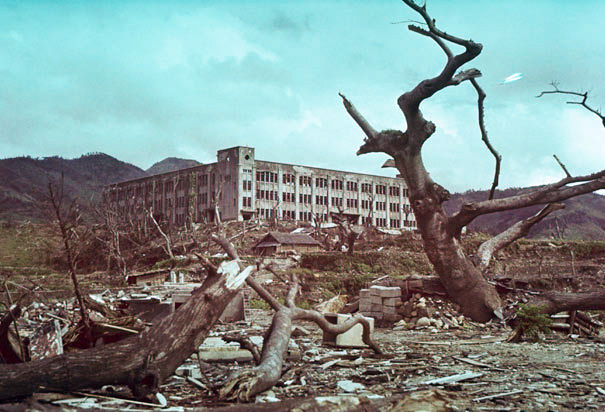
August 6th and 9th represent the 67th anniversaries of the bombing of Hiroshima and Nagasaki. The contested history of the bombings—whether the bomb should have been dropped; how many lives where taken versus how many may have been saved; and the impact of the development of nuclear weapons on the second half of the twentieth century—make it a gripping discussion topic.
On August 6th, the Federation of Atomic Scientists published a series of reflections on Hiroshima. The authors come from a variety of backgrounds: physicists, academics, and Manhattan Project veterans. AHF President Cindy Kelly’s piece on General Leslie Groves, secrecy, and the limited deliberation over the decision to drop the bomb on Japan was included in FAS’ series.
Here are a few excerpts of interviews conducted by AHF with Manhattan Project veterans, highlighting how they feel about the decision to drop the bomb. You may also want to check out this engrossing CNN interview with Theodore “Dutch” van Kirk, the last surviving crew member of the Enola Gay.
Bob Furman, Assistant to General Leslie Groves: “It’s a miracle the bomb was developed. It’s wonderful that we were able to use it to end the war. If it had not occurred—if the bomb had not been dropped and the war had continued, thousands of people would have died on both sides, particularly if we had invaded Japan. We might be talking about a million people in such a terrible invasion process.
“The biggest miracle is, after sixty years now, we have not had another bomb incident. It’s been lucky and we should direct our attention to every effort to prevent any possible occurrence, such as a war which might use nuclear weapons.”
Gordon Knobeloch, Los Alamos chemist: “It was the scientists who made the bomb, but it wasn’t our decision to drop it. That was up to the military or the president, Harry Truman. And Truman truly had no option. I mean, what if he had decided not to use it and gone ahead with a bloody invasion of Japan, which might have failed, but, in any event, that would have killed a lot of people.
“What would he have said to the widows or what would he say to the mothers who lost their sons? If they knew he had a weapon that would have prevented it, and didn’t use it, they would have strung him up by the thumbs, or other parts of the anatomy.
“So I think it was the right decision, and if people ask me if am I sorry for my part, I’m sorry for the people who were killed in Japan. I’m sorry for all the people all over the world who were killed. The Jewish people were exterminated, people were killed in Nanking, if you heard about the Rape of Nanking… It was a sorry thing, but war is a sorry thing to begin with, and I’m proud to have had a part in doing something that might have helped end it a little sooner.”
Mary Michel, K-25 worker: “The night that the news broke that the bombs had been dropped, there was joyous occasions in the streets [in Oak Ridge], hugging and kissing and dancing and live music and singing that went on for hours and hours.
“But it bothered me to know that I, in my very small way, had participated in such a thing, and I sat in my dorm room and cried.”
Ray Stein, Oak Ridge SED: “All I can remember is people just driving up and down the road honking and hollering and shouting. And it was just like a New Year’s Eve ten times over. It was just a wild experience. People were just letting out all this energy all at one time, and being so happy it was over, especially those that had loved ones overseas.
“Since that time, I’ve heard from so many people, men—I belong to a World War II roundtable and several of them said, “We were on our way to Japan when they dropped the bomb, and they turned around and sent us home.” And it just saved so many lives, even though it was unfortunate having to use it. But it did save a lot of lives of Japanese people, and our men.