

Nuclear Museum Logo
Nuclear Museum Logo

National Museum of Nuclear Science & History

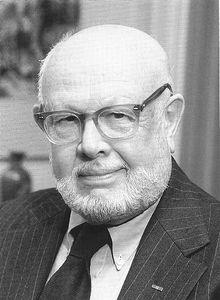
William A. Fowler

PhysicistCalifornia Institute of Technology

Nobel Prize WinnerScientist
William A. Fowler

William “Willie” Fowler was an American physicist who won the 1983 Nobel Prize in Physics.

He received his PhD in physics from Caltech. He spent most his career at Caltech, where he became director of the Kellogg Radiation Laboratory. He was friendly with J. Robert Oppenheimer when Oppie was on the faculty at Caltech before the war. 

Fowler was an experimental nuclear physicist. His most famous paper (which he co-authored with several other physicists) was “Synthesis of the Elements in Stars.” He won the 1983 Nobel Prize in Physics with Subrahmanyan Chandrasekhar “for his theoretical and experimental studies of the nuclear reactions of importance in the formation of the chemical elements in the universe.”

William A. Fowler’s Timeline
1911 Aug 11th Born in Pittsburgh, PA.

1913 Moved with his family to Lima, OH.

1933 Received BS from Ohio State University.

1936 Received PhD in physics from Caltech.

1939 Became assistant professor at Caltech.

1946 Became full professor at Caltech.

1957 Published “Synthesis of the Elements in Stars.

1983 Awarded Nobel Prize in Physics.

1995 Mar 14th Died in Pasadena, CA.

Related Profiles

Dick Kosh

Los Alamos, NM

Dick Kosh was an American physicist.  He worked at the Los Alamos site during the war, arriving from the University of Wisconsin, Madison, and then stayed afterwards.

Elizabeth Painter

Chicago, IL

Elizabeth Painter (later Elizabeth Painter Marcus) was an associate biologist in the Health Division at the University of Chicago Metallurgical Laboratory.

Lawrence H. Johnston

Los Alamos, NM

Lawrence H. Johnston was an American physicist. After receiving his bachelor’s degree in physics from the University of California, Berkeley in 1940, Johnston followed his mentor Luis Alvarez to MIT.

Richard Foster

Hanford, WA

Dr. Richard Foster was the fish laboratory supervisor at Hanford. He talks about inspection of organic matter in the Columbia River prior to and after the construction of reactors at the Hanford site.