



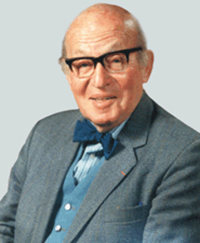
Nicholas Kurti (1908-1998) was a Hungarian-British physicist.
Born in Budapest, Kurti was forced to leave Hungary in 1926 due to anti-Jewish laws. Despite being a gifted pianist, he was denied admission by the Budapest Academy of Music and chose to study physics, chemistry, and mathematics at the University of Paris. He studied physics under Franz Simon at the University of Berlin. When Adolf Hitler rose to power in 1933, Kurti and Simon left Germany and accepted an invitation to join the Clarendon Laboratory at Oxford University.
During World War II, Kurti investigated ways to separate isotopes of uranium as part of Tube Alloys, Britain’s top-secret effort to build an atomic bomb. Kurti’s research was expanded upon during the Manhattan Project.
After the war, Kurti continued his research on low-temperature physics. In 1956, he successfully conducted an experiment that reached a temperature of one microkelvin, one millionth of a degree above absolute zero.
Kurti was a professor of physics at Oxford between 1967 and 1975. A noted cook, he is considered one of the founders of molecular gastronomy. He died on November 24, 1998, at the age of 90.