

Nuclear Museum Logo
Nuclear Museum Logo

National Museum of Nuclear Science & History

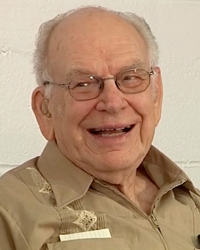
Martin "Ray" Hertz received his Bachelor's degree in chemical engineering and a Master's degree in bacteriology from Iowa State University. In 1941, Hertz entered the United States Air Force as an aeronautical engineer maintaining B-25 bombers fighting the German submarine menace in the Atlantic Ocean. He then was trained to fly B-25 and B-17 bombers and was awarded the Distinguished Flying Cross after leading missions over Germany. 


After the close of the war, Hertz joined Mound Laboratory in January, 1948. There, Hertz was placed in the Source Group and was tasked with making neutron sources using the polonium-alpha-beryllium reaction. Hertz took over the Source Group in 1965, where he remained until 1982.

Martin “Ray” Hertz’s Timeline
1916 Born.

1941 Entered the United States Air Force.

2011 Mar 8th Passed away in Yellow Springs, Ohio.

Related Profiles

Melvin H. Bierman

Hiroshima Mission

Melvin H. Bierman served as a sergeant in the 393rd Bombardment Squadron. Bierman was regularly assigned as a tail gunner in the Up An’ Atom, but did not fly in that plane in the August 1945 bombing missions on Hiroshima and Nagasaki.

Farron Benjamin

Tinian Island

Farron Benjamin served in the last year of the war with the 1027th Air Material Squadron of the 509th Composite Group, first in Wendover, Utah, before transferring to Tinian Island.

L. F. Kogler

Tinian Island

L. F. Kogler served in the 390th Air Service Group.

Harvey L. Piepho

Tinian Island

Harvey L. Piepho served in the First Ordnance Squadron.