


July 16, 2021
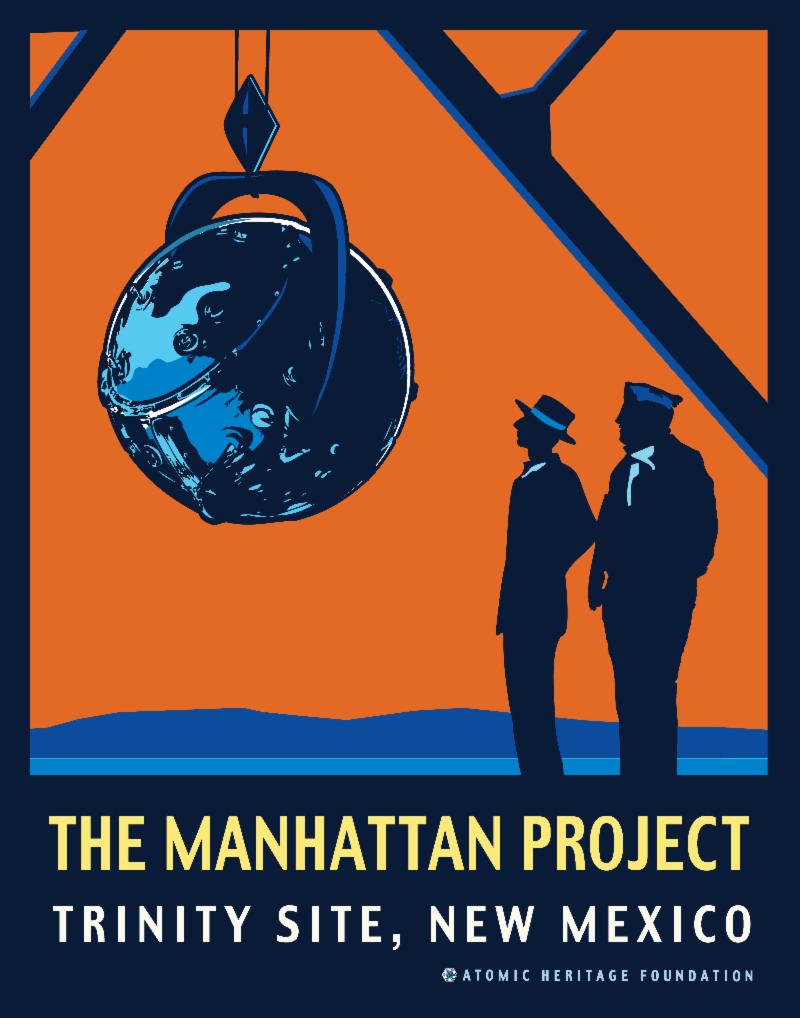
Seventy-six years ago on Monday, July 16, 1945, the efforts of the Manhattan Project dramatically came to fruition. The world’s first nuclear device, the “Gadget,” was successfully detonated in the New Mexico desert. With the “light of a thousand suns,” the nuclear era began.
This issue will explore the unknown risks posed by the test and the Manhattan Project doctors’ concern to protect the scientists, military and others. Eyewitnesses recall being awestruck and hopeful that the war would soon be over. Click on the Ranger in Your Pocket series for some 30 vignettes on the Trinity test with documentary footage and commentary from Manhattan Project veterans and experts.
In addition, this edition honors the late Manhattan Project veteran Irwin P. Sharpe and historian Priscilla J. McMillan. Finally, we have news from some of the Manhattan Project sites today. Enjoy!
Dealing With Unknown Risks
In his excellent book, Atomic Doctors: Conscience and Complicity at the Dawn of the Nuclear Age (2020), James L. Nolan, Jr. explores his grandfather’s role as a doctor in the Manhattan Project at Los Alamos. The following article is largely drawn from Atomic Doctors.
In April 1943, Dr. James F. Nolan (1915-1983) began working as a surgeon, obstetrician, and general physician at the new Los Alamos Hospital. As the Trinity Test approached, the military and scientists were focused on whether the “Gadget” would work and preparing to measure the detonation’s blast and heat. Radiation was a secondary concern.
However, Dr. Nolan’s radiation expertise made him worried about possible radioactive fallout from the test. Working with Louis Hempelmann, head of the Health Group at Los Alamos, Nolan left the hospital to take charge of health and safety monitoring at the Trinity Site.
Complicating matters, no one really knew what a safe level of radiation exposure was. Somewhat arbitrarily, the doctors arrived at 5 roentgens, fifty times higher than the official standard at the time. In contrast, two decades later comparable standards were dramatically lower at 0.006 roentgens.
Hempelmann and Nolan focused on protecting the participants and others living in the area. Scientist Joseph O. Hirschfelder joined them in planning for potential radiation fallout. Meteorologist Jack Hubbard offered advice on how temperature, wind and rain might impact the fallout from the test. Together they developed recommended precautions. The McDonald Ranch House was used as a field laboratory for the Trinity test.
After reading their report, the military still did not seem to take seriously possible radioactive fallout. General Leslie R. Groves asked Nolan, ‘What are you, some kind of [William Randolph] Hearst propagandist?” Despite this, Groves allowed their plans for monitoring the Trinity test to proceed and informed the governor of New Mexico that an evacuation might be necessary.
The energy released from the test was much greater than expected. Fortunately, the mushroom cloud also climbed several times higher than expected, rising between 50,000 and 70,000 feet. This elevation helped to disperse and diffuse the radioactive material.
As Hempelmann said, “We were terribly lucky…There could have been really serious fallout…Parts of New Mexico were fairly heavily exposed, but there weren’t many people there.” (Atomic Doctors, p. 52.)
In 1966, Hempelmann was asked if the test would have been held up if the doctors intervened citing serious risks to human health. His answer was a flat, “No. We couldn’t have stopped it in any possible way.” (Atomic Doctors, p. 45)
With President Truman meeting with his counterparts in Potsdam (see photo above) in mid-July to negotiate the end of the war, the pressure to test the atomic bomb by July 16 was just too great. Dr. Nolan and his colleagues had to compromise their ideals and take part in delivering not just babies but the world’s most destructive weapon.
Click here for more information on the Trinity Test.
Eye Witness to the Trinity Test
Val Fitch: “It’s hard to overstate the impact…. First the flash of light, that enormous fireball, the mushroom cloud rising thousands of feet in the sky, and then, a long time afterwards, the sound. The rumble, thunder in the mountains…After it was over, I saw an MP with an absolutely ashen face. I simply remarked to him, ‘Oh, the war will soon be over.’ Fortunately, I was right.”
Robert Serber: “The grandeur and magnitude of the phenomena were completely breath-taking.”
Maurice Shapiro: “The shock wave from the explosion arrived about one and a half minutes after the flash of light, and I heard it as a sharp report. Although I had expected it, the intensity of the blast startled me. My impression at the time was that an enemy observer stationed about 20 miles from the scene of delivery would be deeply impressed, to say the least.”
Cyril S. Smith: “At the instant after the shot, my reactions were compounded of relief that ‘it worked’; consciousness of extreme silence, and a momentary question as to whether we had done more than we intended. Practically none of the watchers made any vocal comment until after the shock wave had passed and even then the cheers were not intense or prolonged.”
For more, see the “Ranger in Your Pocket” series on the Trinity Site that includes some 30 documentary videos. These vignettes feature Manhattan Project veterans, documentary footage and experts on the history of the site, the “Gadget,” observing the test, and its legacy for the world.
Want to visit the Trinity Site? The next open houses of the Trinity site are Saturday, October 2, 2021 and Saturday, April 2, 2022.
In Memoriam: Irwin P. Sharpe
On March 7, 2021, Irwin P. Sharpe passed away just three weeks short of his 100th birthday. As AHF’s interview in May 2016 attests, he was very intellectually curious and engaged well into his 90s. For more details, see his obituary here.
Born in Brooklyn, New York, Sharpe graduated in mechanical engineering from the University of Michigan in 1942 and began working for General Electric (GE). At a special session at GE’s headquarters in Schenectady, NY, an Army officer explained, “I’m here to invite some of you to join us in a project, which if it is successful, will end the war.” That was all he told them, but it was enough to convince Irwin to sign up.
Employed by the Kellex Corporation, he worked in the Woolworth Building in Manhattan developing vacuum pumps and seals to handle fluorine and uranium hexafluoride gas. He made numerous trips to Oak Ridge to visit the K-25 gaseous diffusion plant under construction. In this mile-long plant, the pumps and seals would become integral parts of the cascade of equipment designed to separate the isotopes of uranium. The enriched uranium produced at Oak Ridge’s plants provided the fuel for the bomb dropped on Hiroshima.
Leaving General Electric in 1957, he founded Irwin P. Sharpe and Associates, a marketing consulting firm. With his wife Libby and their four children, he enjoyed camping, hiking, canoeing, swimming, and skiing.
Irwin reluctantly retired in his mid-80s moving to Middlebury, Vt to be with family members. In his mid-90s, he took political philosophy and photography classes at Middlebury College. He was another awesome Manhattan Project veteran and will be greatly missed.
In Memoriam: Priscilla J. McMillan
Priscilla J. McMillan, a noted historian and author, passed away on July 7, 2021. Born in 1928, McMillan has BA from Bryn Mawr and Masters in Russian Studies from Radcliffe. As the obituary in the Washington Post highlights, McMillan was one of the few people who knew both John F. Kennedy and Lee Harvey Oswald. In “Marina and Lee,” she made the case that Oswald acted alone in President Kennedy’s assassination.
McMIllan had vast knowledge of the Manhattan Project, the Cold War and U.S. nuclear weapons policy and was the bestselling author of The Ruin of J. Robert Oppenheimer. Here are excerpts from AHF’s interview with McMillan in her home in Cambridge, MA from June 6, 2013.
On the success of Los Alamos, McMillan observed: “The scientists had every incentive to work together, not just to work for individual distinction…Perhaps there’s an innate shyness to many scientists that was overcome by the community aspect. They had to work with one another. Their families, their wives, had to be supportive, befriend each other.
“Perhaps that is one of the reasons that alumni of the Manhattan Project looked back all their lives with such fondness on the experience.”
Of Truman’s decision, McMillan commented: “Truman was rather a visceral person. He reacted from the gut. He came to the presidency unprepared, not wanting the job very much. FDR did not take Truman into his confidence [about the atomic bomb]…
“All the pressures on Truman were to end the war quickly, rather than go through a costly invasion of Japan in the fall…Truman was all by himself with a few advisors. An accidental president, he had not been elected in his own right. Even if he had, I believe he would have made the decision he did.”
AHF also recorded McMillan interviewing Nobel Prize-winning physicist Roy Glauber (see photo above) who worked for Oppenheimer both at Los Alamos and later at the Institute for Advanced Study at Princeton.
Glauber described how Oppenheimer had changed after the Atomic Energy Commission [AEC] security hearing in 1954. “He looked worn and exhausted…He was much more carefully spoken.”
“[Oppenheimer’s performance at] the hearing was a kind of defiance saying that he was going to stay the same and be the same. They [The AEC tribunal] saw to it that he could not…That certainly has the element of tragedy…In this male aggressive world, that is what amounts to being crushed.” For more on the Oppenheimer security hearings, click here.
To Richard Rhodes, Kai Bird, Martin J. Sherwin and other many other historians of the Manhattan Project and Cold War, Priscilla McMillan was a beloved friend and colleague. May she rest in peace.
Opening Doors at Los Alamos
On July 8, 2021, the Los Alamos Historical Society (LAHS) unveiled a new exhibit, Opening Doors: The Oppenheimer House Past and Future.This exhibit presents a brief history of house and invites visitors to comment on how the house should be interpreted.
The cottage was originally occupied by May Connell, the sister of Ranch School Director A.J. Connell. An artist, Ms. Connell used the living room with its large northern windows as a studio and slept on the screened porch.
J. Robert Oppenheimer, his wife Kitty, son Peter (b.1941) and daughter Toni (b.1944) lived there from April 1943 to October 1945. Listen to J. Robert Oppenheimer describe his routine of taking Peter to nursery school and eating lunch at the cottage.
The Los Alamos Historical Society is planning to open the house to the public in Fall 2022. To learn more, click here.
Manhattan Project Electronic Field Trip
The National WWII Museum’s “Manhattan Project Electronic Field Trip” used student reporters to explore the Manhattan Project sites. The program includes Robert Franklin (photo above), President of the B Reactor at Hanford, and Elliot Schultz, Historian of Science with the Bradbury Science Museum at Los Alamos, as experts.
The video is designed to engage middle and high school students in learning about the creation of the atomic bomb, the sites where the bomb was produced, its use on Hiroshima and Nagasaki, and how atomic bombs have forever changed the world.