



August 26, 2021 Newsletter
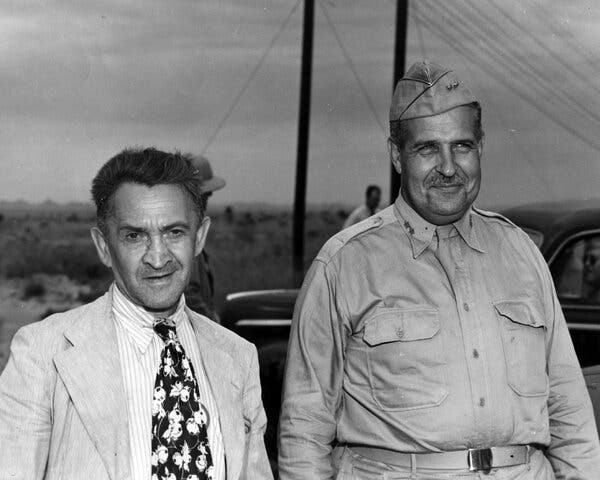
This issue features two articles by science journalist William J. Broad published in the New York Times (Tuesday, August 10, 2021) that probe “the truth behind the news.” The articles contrast New York Times journalist William L. Laurence (pictured above on left with General Leslie Groves) with Black war correspondent Charles H. Loeb. As official reporter for the Manhattan Project, Laurence’s reports were censored by the War Department while Loeb ignored official directives and described the human suffering he saw in Japan.
Manhattan Project veteran Ralph Lapp recounts the experience of the Lucky Dragon fishing boat which inadvertently sailed within 92 miles of the Bikini Atoll hydrogen bomb test on March 1, 1954. The Atomic Energy Commission’s attempted cover up of the story sparked anti-nuclear, anti-American outrage.
The Japanese public broadcaster NHK aired a 75-minute special documentary, “Atomic Bomb Initial Survey – Hidden Truth,” on August 9, 2021. The documentary addresses issues of residual radiation, science and politics.
This newsletter also provides a brief update on the Department of Energy’s (DOE’s) preservation plans for the K-25 site at Oak Ridge, TN. Citing a shortage of funds, DOE has dramatically scaled back on commitments it made in the 2012 Memorandum of Agreement.
In addition, a noteworthy new book, Chasing the Ghost, by Leonard A. Cole, portrays Manhattan Project physicist Fred Reines and his quest for the neutrino. Finally, the National Museum of Nuclear Science & History is presenting two interesting virtual events. Read on!
The Truth Behind the News
New York Times science journalist William J. Broad published two articles in Science Times (Tuesday, August 10, 2021) that examine early reporting on the atomic bombs and the impact of radiation on Japanese civilians. The first article examines how William L. Laurence was being paid by both the New York Times and the Manhattan Project as its official reporter. The second article features Charles H. Loeb, a Black war correspondent who published for the National Negro Publishers Association.
A Lithuanian immigrant who fled Russia in 1905, William L. Laurence graduated from Harvard Law School before becoming a reporter. In an article published in September 1940, “The Atom Gives Up,” he foresaw the awesome potential of harnessing atomic energy.
In early 1944, Laurence was chosen by the Army surgeon general to report on the war in the Pacific islands. In 1945, General Groves recruited Laurence to work for the Manhattan Project inviting him to visit the top-secret Manhattan Project sites, witness the Trinity Test, and observe the Nagasaki bombing as a passenger on The Great Artiste, the instrument plane.
Laurence’s first-hand accounts for the New York Times were reprinted by newspapers nationwide. However, everything Laurence wrote went through the Army’s censors who did not want the public to learn about the human suffering caused by the atomic bombs. As a result, Laurence’s reports downplayed the impact of radiation on the citizens of Hiroshima and Nagasaki.
In contrast, Charles H. Loeb reported that radiation from the atomic bombs was causing devastating illness and death in Hiroshima and Nagasaki. His reports challenged the official US government position. Having studied pre-med at Howard University, Loeb was well versed in science.
Manhattan Project officials acknowledged the radiation from gamma rays and neutrons from the initial blast but not the radiative fallout from the mushroom cloud. Radioactive fragments such as Strontium-90 and Cesium-137 in the cloud fell back to earth in what the Japanese in Hiroshima termed “black rain.” This second wave of radiation caused radiation poisoning long after the initial detonation.
In his press report in October 1945, Loeb described Japanese who were continuing to suffer from radiation poisoning. While General Groves said that the radiation poisoning was “a very pleasant way to die”, Charles Loeb courageously gave Americans a more accurate assessment.
The Story of the Lucky Dragon
Ralph E. Lapp was a physicist who worked on the Manhattan Project in Chicago. After the war, he worked for the Atomic Energy Commission and measured the fallout after the Bikini Atoll hydrogen bomb test. The following is from the AHF’s “Voices of the Manhattan Project” interview in 2002.
“I worked to discover just what it was that took place in an atomic bomb explosion. At Bikini on March 1, 1954, the Atomic Energy Commission exploded a 15-megaton bomb. That is a thousand times the power of the bombs that collapsed buildings in Hiroshima and Nagasaki. This was spectacular by itself, but equally surprising was the radioactive fallout. Highly toxic and persistent fission products such as strontium-90 and cesium-137 were dispersed over an area of thousands of square miles.
Ninety-two miles from where the bomb exploded, a tuna trawler from Japan called the Lucky Dragon was fishing. Not finding fish in the north, it had unwittingly sailed near where the bomb was being exploded. The crew was up just before dawn, and one of the men looked and saw a great flash. He cried, ‘Pikadon! The sun rises in the west!’
They were outdoors, on this little boat, when the bomb went off. Several hours later, radioactive debris of a chalky nature drifted down and descended on the decks of the Lucky Dragon. The men took it off their shoulders and heads. They were very lucky; the Lucky Dragon had a good name…Only one man died, and I think he died of a blood disease.
The story of the Lucky Dragon blew the lid off secrecy. This story had to be told.”
The news reports of the Lucky Dragon and the radioactive fallout from atomic tests in the Pacific created an anti-nuclear movement worldwide. David Ropeik captures this in “How the unlucky Lucky Dragon birthed an era of nuclear fear“, published by the Bulletin of the Atomic Scientists in February 2018.
Since 1976, the Lucky Dragon has been on display at the Tokyo Metropolitan Daigo Fukuryū Maru Exhibition Hall.
Atomic Bomb Initial Survey: Hidden Truth
The Japanese public broadcaster NHK aired a 75-minute special documentary, “Atomic Bomb Initial Survey – Hidden Truth,” on August 9, 2021, the 76th anniversary of the dropping of the Nagasaki bomb. Unfortunately, an English version is not yet available.
According to NHK’s producer Hideharu Watanabe, the documentary had a very positive reception from Japanese audiences. Japanese scientists say that it is the first documentary to focus on “residual radiation” and applauded its focus on science and politics.
There is extensive footage of US servicemen assessing damage to buildings and doctors examining citizens suffering from acute radiation poisoning. Among those interviewed are James Nolan, Jr., author of Atomic Doctors, and atomic bomb survivor and radiation expert Masao Tomonaga.
Dr. Tomonaga, pictured below, is the honorary director of the Japanese Red Cross Nagasaki Atomic Bomb Hospital. In 2019, AHF interviewed Dr. Tomonaga along with the Mayors of Hiroshima and Nagasaki and several hibakusha, atomic bomb survivors. See “Voices from Japan”.
Downsizing Plans for the K-25 Site
For nearly ten years, the Atomic Heritage Foundation worked with the Oak Ridge Heritage & Preservation Association (ORHPA), National Trust for Historic Preservation, and many others to preserve a portion of the mile-long K-25 plant. Built to enrich uranium for an atomic bomb, the mammoth plant employed over 12,000 people in round-the-clock shifts.
Manhattan Project veteran William J. (“Bill”) Wilcox, Jr. tirelessly advocated for the preservation of a portion of the original K-25 building. In 2008, Wilcox (below) presented plans to preserve the North End, the top of the mile-long U-shaped plant. Seeing the authentic facility with its endless procession of diffusion equipment would give visitors a “Wow!” experience.
Ending years of negotiations with consulting parties, in 2011 the Department of Energy (DOE) declared it would demolish the entire K-25 plant. Preservation would be “imprudent,” too costly and dangerous.
In 2012, the Department signed a revised Memorandum of Agreement (MOA) with consulting parties under Section 106 of the National Historic Preservation Act to “mitigate” or compensate for the loss of the K-25 plant. The agreement’s components were to (1) create a K-25 History Center; (2) build a three-story Equipment Building to display a cross-section of the plant and its operations; (3) create a 65-foot-high Viewing Tower overlooking the 44-acre footprint of the former plant; and (4) mark the footprint with landscaping, pathways and 12 wayfaring exhibits.
Senator Lamar Alexander and other members of the Tennessee Congressional delegation championed the K-25 efforts and the appropriation of some $20 million. In 2020, DOE opened the K-25 History Center (above) on the second floor of an operating fire station. In a relatively small space, the exhibits provide a good introduction to the K-25 plant and its history.
The equipment building, viewing tower, and footprint with its signage would have complemented the history center’s exhibits. An early artist’s rendering of the equipment building shows a cross-section of the three-story plant. Visitors could have walked down the long alley and seen the parade of compressors, converters, and pipes, or explored the operating floor above.
However, on August 3, 2021, DOE released a revised MOA, explaining that completing the rest of the 2012 plan would “exceed appropriated funding.” The equipment building will not be constructed. Likewise, the 65-foot viewing tower overlooking a landscaped footprint will be dropped.
Instead, a viewing platform of unspecified height, visual indicators at each corner of the footprint, and 12 way-finding exhibits will be built over the next five to ten years.
In the 2015 agreement with the National Park Service (NPS) establishing the Manhattan Project National Historical Park, DOE committed to request the necessary funding to preserve and maintain its historic resources.
Working with Congress, DOE needs to honor that commitment by seeking the funds for the 2021 MOA’s scope of work. We need to preserve and interpret what is left of the K-25 site and remember what was once an icon of the Manhattan Project.
Chasing the Ghost
Chasing the Ghost: Nobelist Fred Reines and the Neutrino by Leonard Cole is an engaging biography of Manhattan Project physicist Fred Reines who was the first scientist to “sight” the extraordinarily elusive neutrino in the mid-1950s.
Nicknamed the “ghost particle,” neutrinos are very small subatomic particles that are exceedingly hard to detect as they rarely interact with matter. Roughly a thousand trillion pass through our bodies every second.
In an article in Nature in 1934, Hans Bethe and Rudolph Peierls predicted the chance of detecting a neutrino as less than one in several billion. Fred Reines and Clyde Cowan aptly called their research “Project Poltergeist.” In 1956, they reported “seeing” a neutrino for the first time. Belatedly, in 1995, Reines was awarded the Nobel Prize for this discovery.
After receiving a PhD in physics from New York University, Reines moved to Los Alamos in 1944 to work with Richard Feynman and other Manhattan Project luminaries. After the war he worked on diagnostic experiments for nuclear tests until 1951, when he shifted his focus to the neutrino.
Among his closest friends at Los Alamos were Louis Rosen, George Cowan, and Harris Mayer. In an AHF interview in October 2017, Mayer commented, “Fred was head of the Pogo staff, and in my mind, he would have become the next director of the laboratory. He told Carson Mark, ‘I don’t want to do anything now but think about science.’ Fred sat for one year thinking about science and out came the neutrino!”
Upcoming Events from the NMNS&H
AHF’s partner, the National Museum of Nuclear Science & History (NMNS&H), has two interesting upcoming virtual events. Click on the dates below for more information.
On August 27, 2021, a musicologist will provide a guide to the music used on Cold War television programs about the atomic bomb (1950 – 1969). Tune in!
On September 17, 2021, Alan Carr, Senior Historian of Los Alamos National Laboratory, and Dr. David Kenyon, Research Historian at Bletchley Park will compare the lives of Los Alamos researchers and the Bletchley Park codebreakers led by Alan Turing.