




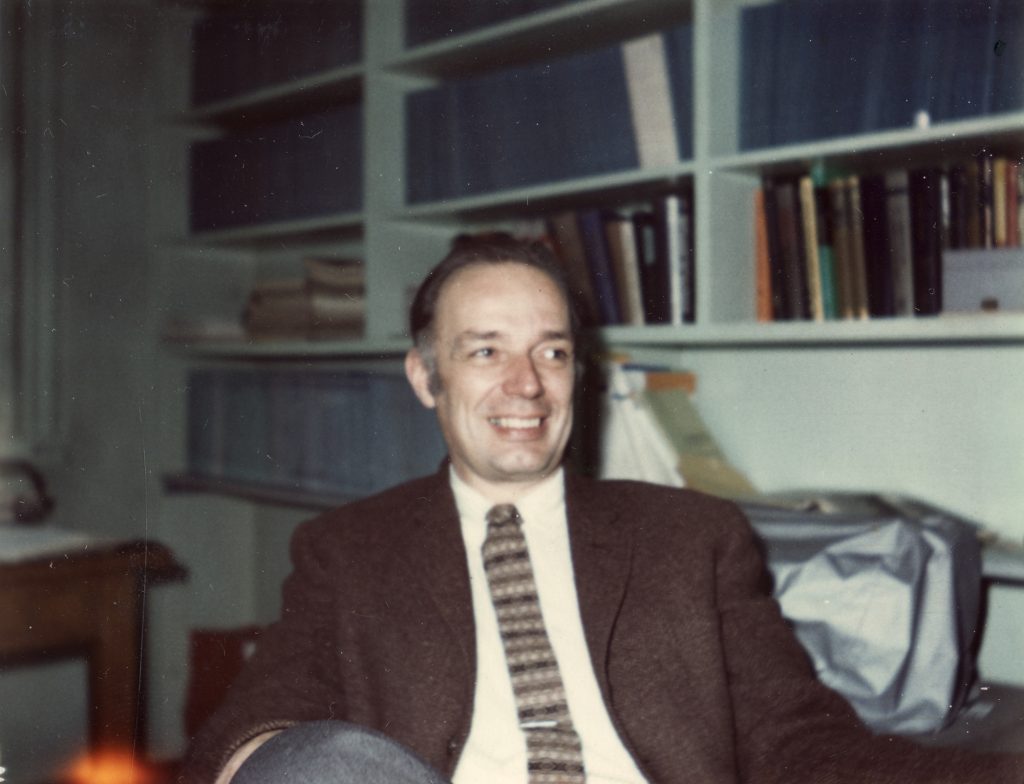
Philip McL. Stehle was an influential American theoretical physicist whose academic career spanned much of the mid-to-late 20th century. Born on March 3, 1919, he completed his bachelor’s degree at the University of Michigan before earning a Ph.D. in physics from Princeton University with a thesis on “Star Streaming,” supervised by prominent mathematician Howard Percy “Bob” Robertson. During World War II, Stehle served as a specialist in the U.S. Army and contributed to the Manhattan Project as a theoretical physicist under the leadership of J. R. Oppenheimer — an early professional experience that placed him at the heart of one of the most significant scientific efforts of the 20th century.
After the war, Stehle transitioned to academia, teaching briefly at Harvard before joining the University of Pittsburgh in 1947. Over his long tenure there, he became a central figure in the Department of Physics and Astronomy, serving twice as its chair and helping to set the department on a productive research path. His foresight led him into emerging fields such as quantum optics, anticipating the future importance of laser research and its applications long before they became mainstream. Stehle’s long-term commitment to research and teaching earned him multiple Fulbright Fellowships at the University of Innsbruck and later an honorary doctorate from that institution in recognition of his contributions to fostering excellence in quantum physics.
Stehle was also a prolific author, writing several influential physics textbooks and scholarly works that have helped educate generations of students. His books include foundational texts on classical mechanics, quantum mechanics, and the transition between classical and quantum physics, with Order, Chaos, Order: The Transition from Classical to Quantum Physics being noted for its intellectual depth. In addition to his books, he published articles in respected journals and contributed to the broader physics community through both research and mentorship. At the time of his death in 2013, Stehle was professor emeritus at the University of Pittsburgh, leaving a legacy of academic leadership and scientific contribution.