



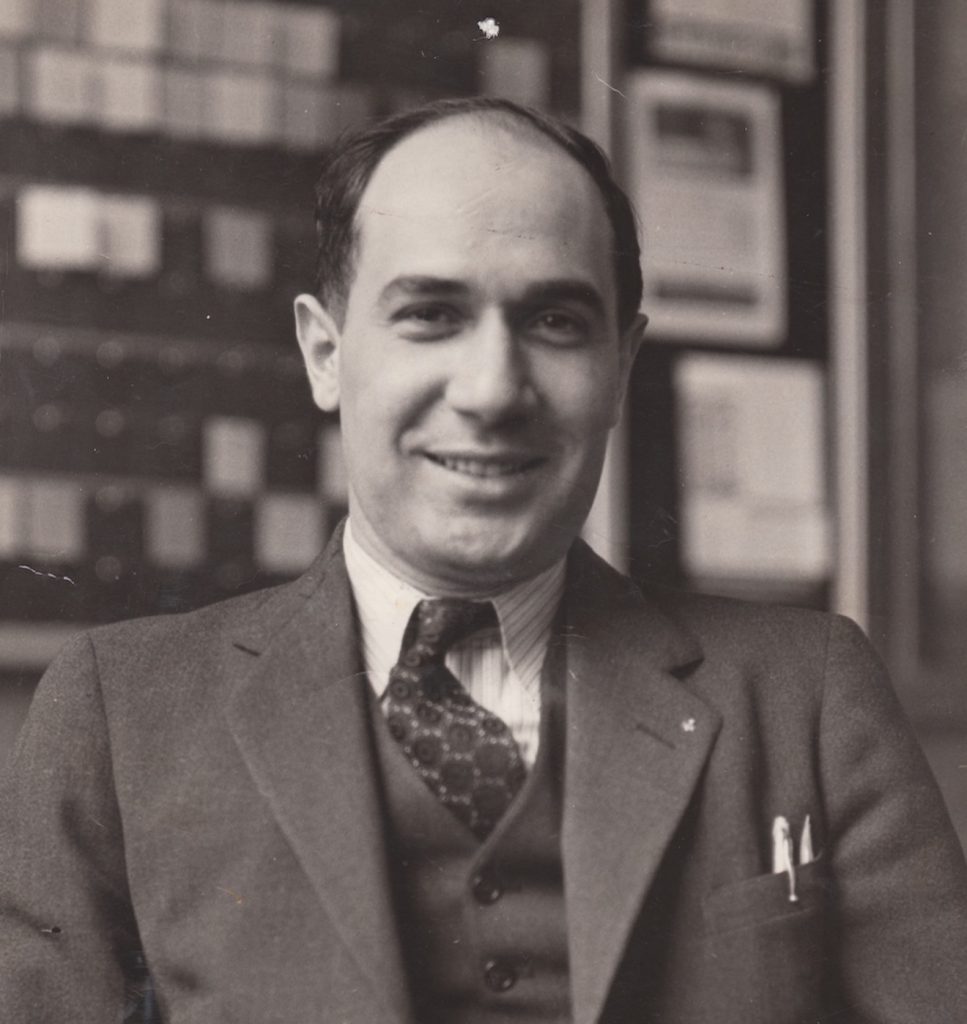
Benjamin (Ben) Miller began his career path to electrical engineering in the 1920s. After dropping out of high school in the 11th grade and working at a number of odd jobs, he was hired and trained as a lineman by the Philadelphia Electric Co. In 1929, Ben found employment in the factory at the Brown Instruments Co of Philadelphia (later merged with Honeywell Inc). He was mentored by the company owner who saw promise in this hard-working young man and encouraged him to study electrical engineering. Ben first obtained his high school GED, then enrolled in Drexel Institute of Technology (now Drexel University). He worked at Brown Instruments during the day, and attended classes in the evenings. In 1936, he received his Bachelor Degree in Electrical Engineering and was promoted to the Honeywell Research Engineering Laboratory where he developed an electronic device which the company patented and successfully marketed. During his 43-year career at Brown Instruments/Honeywell Industrial Products Division, he moved through the ranks from factory assembly line, to research engineer, to field service engineer, to Philadelphia Branch Manager, to Eastern Regional manager, and finally retiring in 1971 as National Service-Market Manager. Along the way, he worked on the Manhattan Project in Oak Ridge, TN, assisted with the development of the Heart-Lung Machine, directed Honeywell’s contribution to the White House renovations during the Truman presidency, engineered electronic equipment for Albert Einstein’s laboratory at Princeton, and managed Honeywell’s involvement in the NASA Apollo Moon Program in the 1960s.
With the outbreak of the Second World War, Ben was assigned to a number of national defense projects where he applied his engineering skills at military bases in both the US and Canada, and at homeland war supply manufacturers. In 1944, he was chosen by Honeywell to participate in the Manhattan Project at the Oak Ridge site. While he never disclosed to his family the nature of his work, he did relate some details about his journey from Philadelphia to the site, as well as the extraordinary security measures. He traveled by train to Washington DC where he was met by a federal agent who directed him to another train. When he arrived in TN, he was met by an agent with a station wagon, and he and several others from the train were then driven to the Oak Ridge site. He was confined to a work area with a small group of engineers and had no contact with other groups. No one in his group had knowledge of what their work was contributing to. On one occasion, after observing materials being burned at a far corner of the reservation every evening, Ben commented at dinner to his small group of associates that either radioactive or biological materials were involved. Shortly after dinner, he was summoned and interrogated by federal agents. Convinced that it was only his conjecture, he was released and told that in the future if he had any thoughts, to keep them to himself. He followed that directive up until his passing in 1983. On another occasion, he mentioned in a letter to his wife back in Philadelphia that it had been raining for days. All mail was reviewed by a censor, and that sentence was cut out because it might have given clues to where he was stationed. All mail was routed through a PO Box address in Washington DC. Ben departed Oak Ridge in July 1945 and returned home shortly before the first atomic device was tested in Los Alamos. It was only then that he realized the importance of his work.
Following his death in 1983, a security badge marked Clinton Engineering Works and a square of parachute silk labeled “Oak Ridge 1945” were discovered among his papers. Unfortunately, they were accidentally lost over the years, but a photo of the badge remains.