



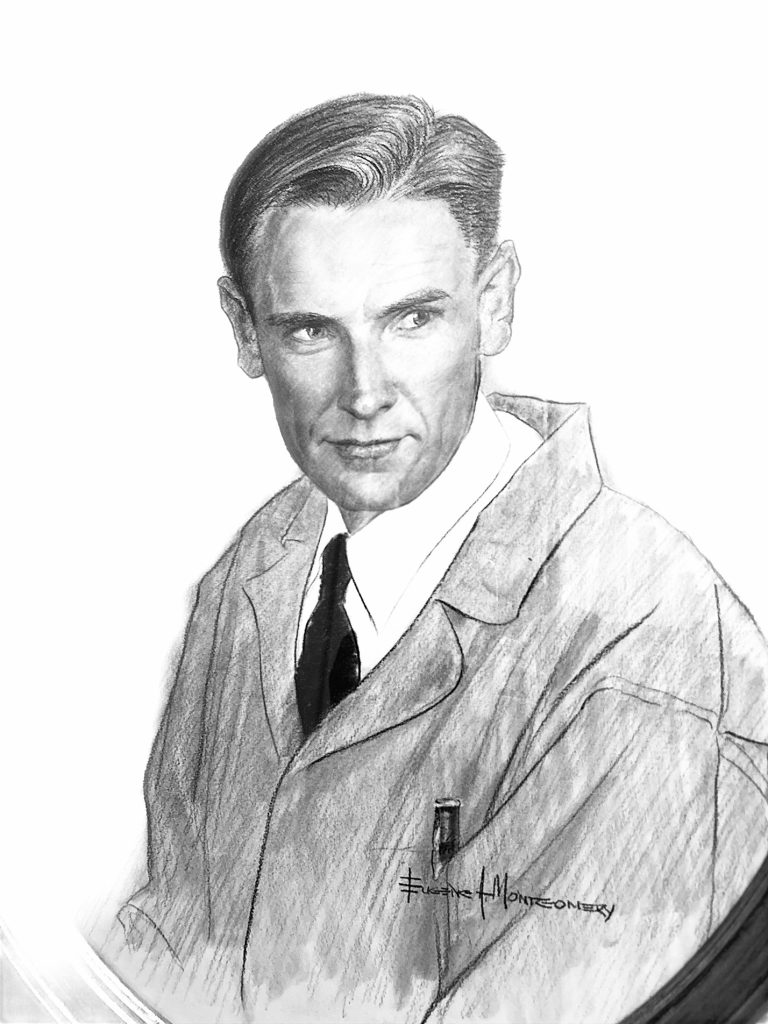
Eugene Gardner was a student of Ernest Lawrence in the 1940’s and did his graduate work as a part of Lawrence’s group at the Radiation Laboratory at UC Berkeley. This was the time when the group was doing the research for the process of electromagnetic separation of U235 using the cyclotron. Gardner received his PhD in 1943 with a thesis on calutron ion sources and continued as a post-doc in Lawrence’s group as that research continued. In 1944, Lawrence sent a part of his group, including Gardner, to Oak Ridge, to establish the work of electromagnetic separation of U235 at the Y-12 plant.
In the first few months of the group’s work, they implemented the plan developed at Berkeley, which was to set up a number of cyclotrons, in a series called a racetrack. The natural uranium cycled through the series, gradually increasing the concentration of U235 to purity. In theory. Actually, in the first few weeks of production, they produced no pure U235 at all. Gardner helped design and develop the Beta racetrack process which took the partially separated U235 from the Alpha racetrack, and purified it to a level where it could be used in the uranium bomb. He then continued, for a year, to work at Oak Ridge as the scientific head of one of the Beta racetrack buildings.
In June, 1945, when that process was running smoothly, Gardner went to Los Alamos, to help with the final work on the implosion method for the plutonium bomb. There he worked on the initiator for the bomb, the piece at the center, the Urchin, composed of beryllium oxide and polonium, which, at the moment the explosives on the outer layer of the bomb went off, would release a burst of neutrons to increase the intensity of the chain reaction.
When that work was complete and the plutonium bomb was ready for testing, Gardner went to Wendover, Utah, to work with Robert Brode’s group which was tasked with developing a fuse that would reliably cause the bomb to detonate at a certain height.
After the war was over, Gardner returned to the Radiation Lab in Berkeley, to head up a group to investigate the very short-lived particles that form when a proton breaks apart. Then called pi-mesons, these are now called pions. Gardner and his colleague Cesar Giulio Lattes, a Brazilian physicist, collaborated to record the first photographs of artificially produced pions, produced by the 184” cyclotron. Their paper was published March 12, 1948, in the journal Science.
Gardner’s life was cut short as a result of his exposure to beryllium oxide dust, which he breathed during the time he was working at Los Alamos. At the time, the toxic effects of beryllium oxide were not known in the scientific community. He developed lung disease in 1946, but his doctors did not discover that it was caused by beryllium until shortly before his death in 1950. He died in the Veteran’s Hospital in Vallejo on November 26, 1950 at the age of 37.