




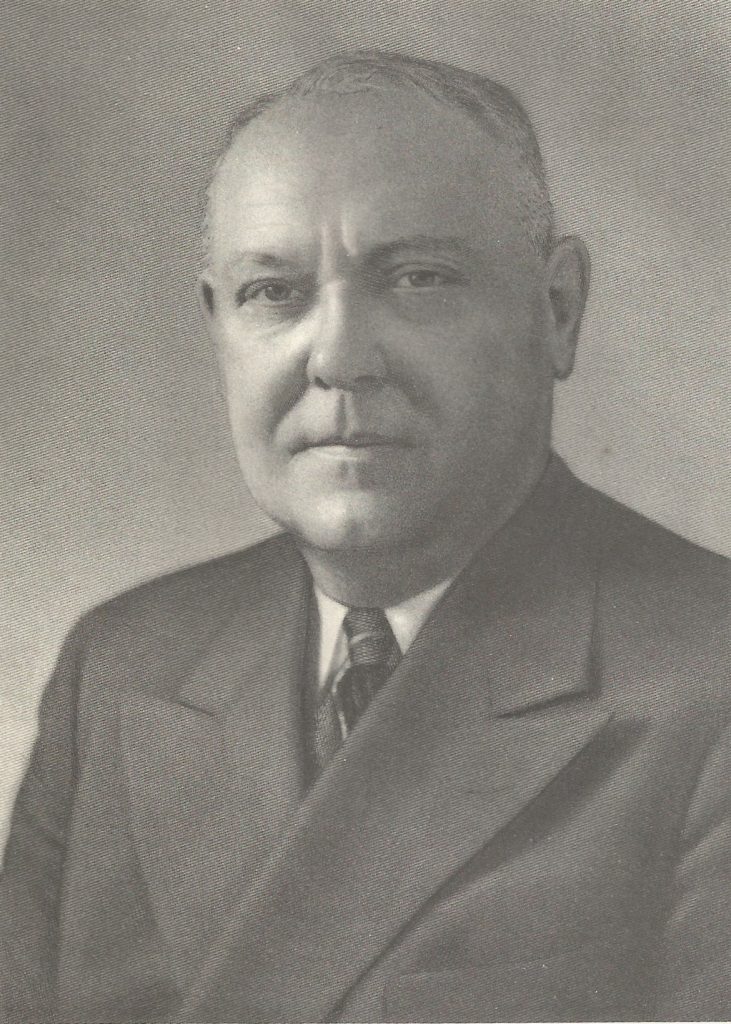
Harold Raymond Austin was an American engineer and business executive whose career spanned nearly six decades. Born in Norwalk, Connecticut, in 1883, Austin studied technical subjects at Pratt Institute in Brooklyn. He began his career in 1901 as a draftsman with the Buffalo Forge Company, where he worked alongside Willis H. Carrier on an early system for regulating temperature and humidity that was a forerunner of modern air conditioning. In 1905, Austin joined the M. W. Kellogg Company, where he advanced through a series of engineering and management positions, eventually becoming executive vice president and later president.
Under Austin’s leadership, Kellogg grew into a major engineering and construction company serving the petroleum, chemical, and manufacturing industries. The company developed important technologies, including catalytic cracking and hydroforming, and expanded its work during World War II to support the nation’s war effort. Kellogg produced equipment for ships and military facilities, contributed to the synthetic rubber program, and constructed facilities for the production of critical wartime materials.
Austin’s most significant wartime contribution came through the Manhattan Project. In 1942, Kellogg was tasked with designing the massive gaseous-diffusion plant at Oak Ridge, Tennessee, for separating uranium-235 from natural uranium. Austin helped organize and staff Kellex, a Kellogg subsidiary created specifically for the project, and was responsible for helping oversee the design, development, and procurement of the equipment and materials needed for the plant. Construction began in 1943, and the facility reached full production in June 1945, five weeks ahead of schedule. After the war, Austin continued his work in engineering and government, serving as vice-chairman of the Munitions Board in 1951. He remained active in business and engineering for many years and received an honorary Doctor of Science from Pratt Institute in 1969. Austin died in Palm Beach, Florida, in 1970 at the age of 87.