




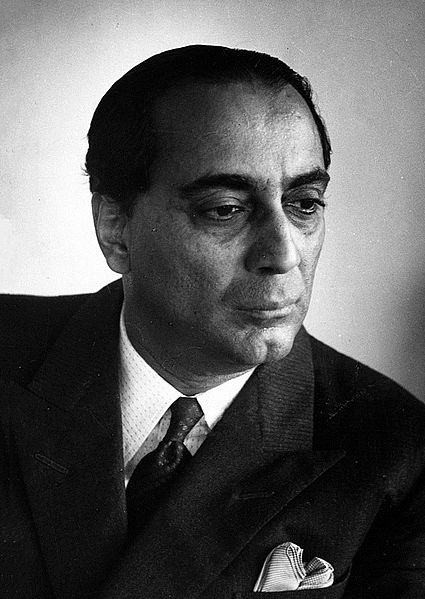
Homi Jenhagir Bhabha (1909-1966) was an Indian physicist who is often considered the father of the Indian nuclear program.
Bhabha was born to a wealthy family in Mumbai. In 1927, he went to England at Cambridge University. Although he began studying engineering per the wishes of his family, Bhabha was quickly drawn to physics. “I seriously say to you that business or job as an engineer is not the thing for me,” wrote Bhabha in 1932. “It is totally foreign to my nature and radically opposed to my temperament, and opinions. Physics is my line. I know I shall do great things here.” Bhabha earned a Ph.D. in nuclear physics in 1934.
Bhabha returned to India before World War II to join the Indian Institute of Science, where he founded the Cosmic Ray Research Institute. In 1945, he founded the Tata Institute of Fundamental Research, where initial research for India’s nuclear program began. Shortly after India’s independence in 1947, Bhabha wrote to Prime Minister Jawaharlal Nehru, arguing that “within the next couple of decades, atomic energy would play an important part in the economy and the industry of countries and that, if India did not wish to fall even further behind industrially advanced countries of the world, it would be necessary to develop this branch of science.”
In 1954, Bhabha founded a nuclear research center at Trombay which was later renamed the Bhabha Atomic Research Centre (BARC). A strong proponent of nuclear energy, Bhabha organized the first UN Conference on the Peaceful Uses of Atomic Energy in 1955. He was the head of India’s nuclear program until his death.
Homi Bhabha died in a plane crash on the way to Geneva on January 24, 1966.