


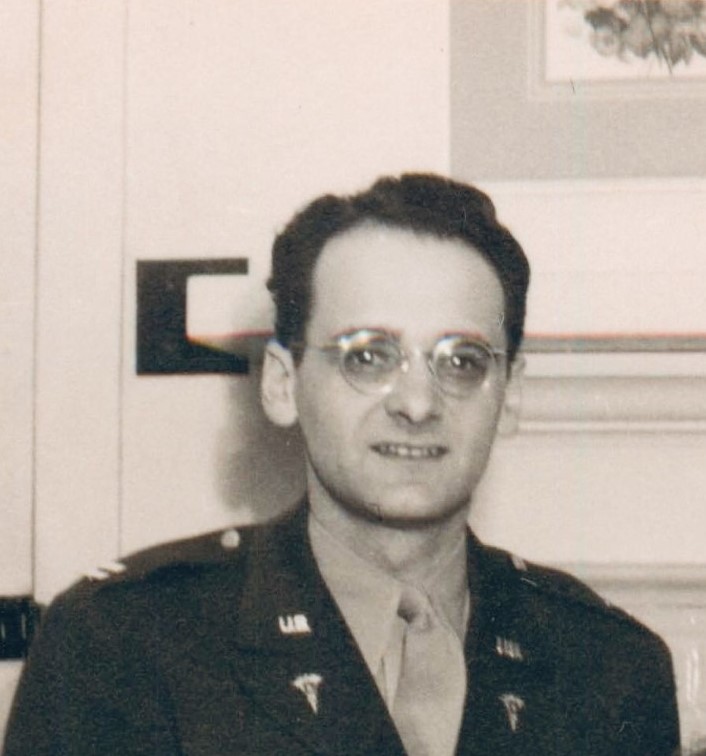
Howard H. Belgorod, D.D.S., was born in Manhattan on January 11, 1915. He was the second son of Harry and Minnie Belgorod. He was 90, almost 91.
Childhood
Howard’s father, Harry Belgorod, attended City College of New York. That is where the best and the brightest of his generation went for college. Like many of his peers at the time, his higher education was fragmented and was finally ended by the Great Depression. Despite Howard’s father, Harry, not having any formal science education, my father remembered Grandpa Harry as being able to pick up Howard’s physics book, read it once, and teach him the lesson. Harry was a passionate bibliophile, providing intellectual stimulation to Howard in his youth and throughout his adulthood.
A sizeable parcel of land in downtown Brooklyn that Harry owned jointly with his two brothers had been sought after by the Capitol Theater chain. Unfortunately, it lost most of its value in a short period of time due to the economic downturn. Had the land been sold in a timely fashion, as Harry had urged, it would have made the Belgorod family financially secure during the Depression. The family survived, nevertheless.
Howard’s mother, Minnie, ran a small family business, which provided the necessities for the family during the uncertain Depression era. There was no doubt in Minnie’s mind that higher education was unequivocally one of those necessities. Against all odds, in a bad economy, and battling against her failing health and Grandpa Harry’s retinal disease, they were able to afford to send both of their sons to college and to professional school through hard work and determination. The Belgorod sons became those educated men she envisioned.
Education and Sense of Duty
Howard attended DeWitt Clinton High School, a massive, public, all-boys school in the Hell’s Kitchen section on the West Side of Manhattan. He excelled academically and was remembered by a classmate, who recounted that Howard once sang a solo before an auditorium filled with thousands of rough-and-tumble young men at DeWitt Clinton. Howard reportedly held the huge audience spellbound with his clarity of voice, so that one could have heard a pin drop in the otherwise rowdy crowd.
Howard was offered a sought-after, full scholarship to Wesleyan University in Connecticut. He turned it down, however, to remain in New York City to be near his ailing mother. Howard’s mother, Minnie, was dying from the long-term effects of diabetes mellitus acquired in the pre-insulin era. Howard determined that he could not go out of town for college, even at the expense of giving up his cherished scholarship. Instead, he attended New York University for his undergraduate studies, followed by New York University School of Dentistry, from which he graduated in 1940. We usually do not remember Howard for his athletic prowess, but rather for his intellect and humanity. Surprisingly, however, he did go out for track and field as an undergraduate.
World War II
Howard initially established his dental practice in Greenwich Village. He enlisted in the US Army when World War II broke out. After basic training at Carlisle Barracks in Carlisle, PA, he was sent to Camp Breckenridge and joined the staff at Nichols General Hospital in Louisville, KY. During this period, his family and friends expressed concern that he was being investigated by the FBI. Unbeknownst to even Howard himself, he was in the process of being issued a high-level security clearance for the Manhattan Project, the top-secret wartime project to develop the atomic bomb, which greatly facilitated the Allied victory in the war in the Pacific. A lifelong quest for Howard was to learn who it was who recommended him for the Manhattan Project. He was never to find out.
The Manhattan Project
Howard’s first Manhattan Project assignment was in Oak Ridge, TN. Howard was next transferred to the top-secret facility at Los Alamos, NM. The hastily constructed town was literally in the middle of nowhere, at a former boys’ school atop a mesa in the New Mexico desert. It remained nameless to those on the outside. Like all Los Alamos residents, Howard’s mail and phone calls were censored. It was not unusual for mail to be sent out of Los Alamos with entire sentences or paragraphs, literally, cut out of the paper upon which they had been written. Secrecy was a way of life in Los Alamos. Los Alamos was to remain at his home until several years after the War.
Howard joined the staff of the Army hospital, where he quickly became known as a very hard-working and meticulous dentist. All of Los Alamos knew that if dental work was to be done properly, my Howard was the man to do it. He was eventually joined in Los Alamos by his wife Madeline (nee Bloom) and newborn son Morie. He had daily interactions with the plethora of Nobel laureates, for whom he provided care. After the war, Howard returned to New York City to re-establish his dental practice. In 1953, his second son was born.
Dental practice
Howard always put the needs of his patients before his own. He was a meticulous clinician with the highest standards of ethics. Although he retired over fifteen years ago, after practicing dentistry for fifty years, it was common for patients to call him at home to let him know that their dental work of decades ago was still going strong and was the best that they had ever had. He was renowned for seeing patients in distress after hours, at any time, day or night. He could not bear to permit a patient to suffer when he could relieve that suffering.
He had an old-fashioned sense of duty. He treated patients without regard for their ability to pay for his services. He cared for so many patients whom he never even thought of charging. He often paid for indigent patients’ dental laboratory bills out of his own pocket. He expected nothing in return. He believed in the dignity of the healing arts, and he trusted in the integrity of those who sought his care, saying, “They will pay me if and when they can.”
Howard is survived by his devoted wife of 62 years, Madeline, his loving sons Morie and Barry, his adoring granddaughter Margot and his admiring grandsons Gregory and Douglas. He will be missed by all those whose lives he touched and improved.