



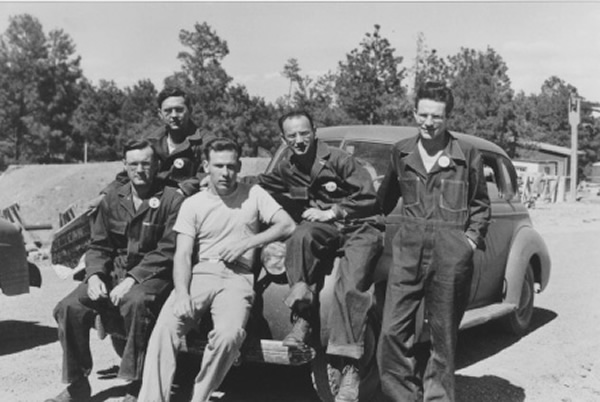
Monroe Messinger was born in New Jersey and grew up in Brooklyn and Long Island. He received a Bachelor of Science degree from the College of the City of New York. While in college, he joined the Army in the Enlisted Reserve in 1942 and was called up in 1943. After basic training, Messinger was sent to the Army Specialized Training Program (ASTP) to study civil engineering and surveying. These skills became particularly useful when he was transferred to Los Alamos later that year.
He served as a Staff Sergeant in the Special Engineer Detachment at Los Alamos. He was in charge of the first SED unit at Los Alamos. Messinger worked in an Explosives Testing and Research Group under George Kistiakowsky, which was involved in the handling and firing of high explosives and used high-speed rotating mirror cameras and associated photographic techniques. The latter part of his work at Los Alamos was in the Optics Group working on applications of photography to data recording in research techniques. After the war ended, he was sent to Japan as part of the team to analyze the bombs’ effects and the Japanese high-speed photography research.
Messinger went on to a career as an analytical research director for Chesebrough-Ponds (now Unilever). He enjoyed traveling with his wife and riding motorcycles.