



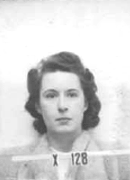
Peggy Eileen (Johnson) Titterton was a laboratory assistant at Los Alamos and the wife of physicist Ernest Titterton.
Born in 1921 in Worcestershire, England, Peggy Titterton developed an interest in science while attending the Girl’s Grammar School in Kidderminster. After working in a metallurgical laboratory, she became a laboratory assistant in the Department of Physics at Birmingham University, where she met Ernest Titterton. There she performed a mixture of technical and typing jobs, and helped Ernest build a prototype of his triggered spark-gap modulator. The two married in 1942.
In 1943, Ernest and Peggy Titterton moved to Los Alamos as part of the British Mission to the Manhattan Project. At Los Alamos, Peggy Titterton worked as a laboratory assistant. After the war, Peggy cared for the couple’s three children and worked in the gardens at their home in Forrest, a suburb of Canberra, Australia.
The Tittertons divorced in 1986, and Lady Titterton died on October 14, 1995, in Canberra, Australia.