


Nuclear Museum Logo
Nuclear Museum Logo

National Museum of Nuclear Science & History

Werner Heisenberg

PhysicistGermany

German Atomic Bomb ProgramNobel Prize WinnerScientist
Werner Heisenberg

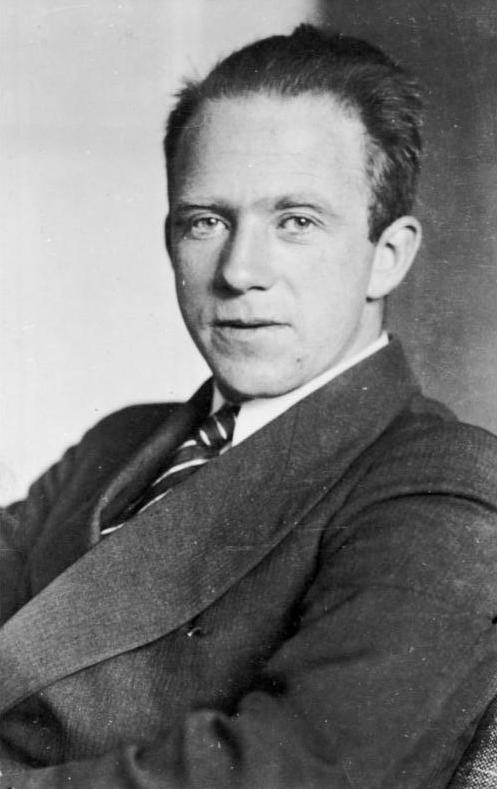
Werner Heisenberg (1901-1976) was a German theoretical physicist and 1932 Nobel Prize winner.

Heisenberg was a main contributor to the German atomic program during World War II, in direct competition with the Manhattan Project. In 1941, he visited Niels Bohr in Copenhagen to discuss nuclear research. Nazi architect Albert Speer consulted Heisenberg about the possibility of turning the knowledge into a nuclear weapon. Heisenberg told Speer that a bomb could not be built before 1945, and would require significant monetary and manpower resources. By the end of 1942, it was apparent the German nuclear energy program would not end the war effort in the near term. Instead, German scientists focused their efforts on more pressing matters which would have an immediate impact on the war.

In 1943, the Manhattan Project established the Alsos Mission to investigate German progress in developing a nuclear weapon. The United States took numerous German nuclear scientists into custody throughout 1944 and 1945. Heisenberg and a number of other prominent German physicists were interned at Farm Hall in England immediately following the war.
 

Scientific Contributions

Heisenberg is best known for his uncertainty principle and theory of quantum mechanics, which he published at the age of twenty-three in 1925. He was awarded the Nobel Prize for Physics in 1932 for his subsequent research and application of this principle.

For more information on Heisenberg’s scientific achievements, visit the Nobel Prize website.

Werner Heisenberg’s Timeline
1901 Dec 5th Born in Würzburg, Germany.

1923 Received Ph.D. in Physics at the University of Munich.

1932 Awarded the Nobel Prize in Physics for “for the creation of quantum mechanics, the application of which has, inter alia, led to the discovery of the allotropic forms of hydrogen.

1945 May1946 Interned at Farm Hall as part of the Manhattan Project’s Alsos Mission to determine German scientists’ knowledge regarding the development of an atomic bomb.

1976 Feb 1st Died in Munich, Germany.

Related Profiles

Donald W. Kerst

Los Alamos, NM

Donald William Kerst is an American physicist known for his development of the betatron in 1940 and the Water Boiler Reactor at Los Alamos during the Manhattan Project.

Percy Spencer

Cambridge, MA

Percy Spencer was an American physicist and inventor. Spencer was born in 1894 in Howland, Maine. He dropped out of grammar school at age 12 to work as a spindle boy in a weaving mill, but in his early years he taught himself about electricity, even setting up a new electrical system at a local […]

Edwin McMillan

University of California, Berkeley

Edwin McMillan (1907-1991) was an American physicist and winner of the 1951 Nobel Prize in Chemistry.

John W. Gofman

University of California, Berkeley

John W. Gofman was an American scientist who helped develop plutonium separation techniques during the Manhattan Project.