

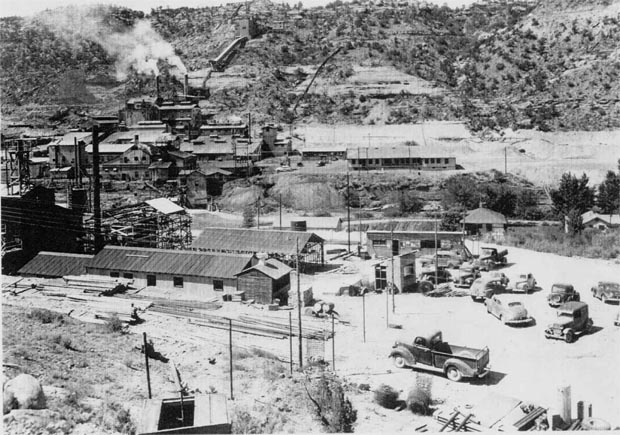
Grand Junction, Colorado, was the epicenter of domestic uranium procurement during the Manhattan Project. In March 1943, the Manhattan Project sent Philip C. Leahy, a Second Lieutenant with the U.S. Army Corps of Engineers, to Grand Junction to establish the new Colorado Engineers Office. A downtown office served as the main administrative location, while a former gravel pit located behind the municipal cemeteries was transformed into a uranium refinery.
Throughout World War II, operations in Grand Junction served as the regional headquarters for the U.S. Vanadium Corporation. The company processed vanadium tailings for their uranium content at mills in Durango and Uravan, Colorado. The uranium concentrates were then sent to the refinery in Grand Junction for further processing. By the end of the war, over 2,600,000 pounds of uranium oxide had been produced from Colorado Plateau material, representing 14% of the total uranium acquired by the Manhattan Project.
Following the war, Grand Junction continued to play a vital role in uranium procurement during the Cold War under the Manhattan Project’s successor agency, the U.S. Atomic Energy Commission.
Today, the site of the former uranium refinery is home to the Atomic Legacy Cabin, a free interpretive center where visitors learn about the site’s history and contributions to the Manhattan Project and U.S. Atomic Energy Commission eras.