


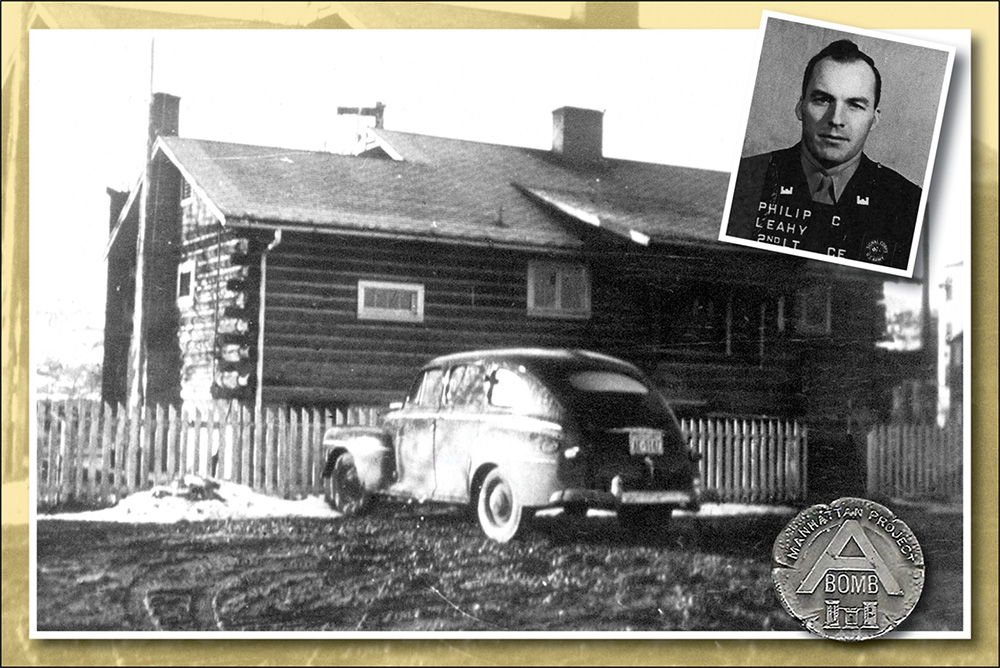
Philip C. Leahy was a Second Lieutenant for the U.S. Army Corps of Engineers who began his work for the Manhattan Project at the Metallurgical Laboratory at the University of Chicago, Illinois. Leahy oversaw a team that moved the world’s first nuclear reactor, Chicago Pile 1, to a location outside of the city, codenamed Site A.
In 1943, Leahy met with Lieutenant Colonel Thomas T. Crenshaw, who supervised the project’s procurement of uranium — the critical ore needed for the atomic bombs. It was during this meeting that Crenshaw told Leahy to pack his bags and board a train for a new assignment. It wasn’t until Leahy got off the train that he knew where the project was: Grand Junction, Colorado.
As the head of the Manhattan Project’s newly established Colorado Engineer Office, Leahy’s assignment was to procure as much uranium as possible from the Colorado Plateau. He set up his office in downtown Grand Junction. He also purchased 55 acres of land for $10,500 that was tucked away behind Grand Junction’s municipal cemeteries. Workers quickly converted the former gravel pit into a new uranium refinery. A log cabin on the property served as the refinery’s office.
The site was the perfect place for a secret operation. It already had a rail spur where workers could load and ship materials without inviting public scrutiny. Although it was just outside city limits, there was little drive-by traffic. The Gunnison River ran along the west side of the site, supplying plenty of water for refinery work and limiting outsider access by land.
By 1946, the Colorado Plateau had produced more than 2.6 million pounds of uranium oxide, or “yellowcake,” which was about 14% of the total uranium acquired for the Manhattan Project. At the time, the public knew little about the mill’s activities. News reports claimed the mill produced vanadium, an important steel-hardening element used in the war effort.
Similarly, Leahy himself was in the dark about the purpose of his secret assignment. Interviewed by Grand Junction’s The Daily Sentinel in 1988, Leahy admitted that he “didn’t know what the material was needed for. They just told me to go get it.” Leahy only began to understand the significance of his procured uranium after the Trinity Test on July 16, 1945.
Following the end of the war and his retirement from the Army, Leahy returned to Grand Junction to manage what was now the Colorado Raw Materials Office for the U.S. Atomic Energy Commission (AEC), the Manhattan Project’s successor agency. This government agency continued to secure domestic uranium from the Colorado Plateau throughout the Cold War era.
Today, Grand Junction’s involvement in the Manhattan Project is no secret. In 2001, the U.S. Department of Energy (DOE) transferred ownership of the former refinery site to the Riverview Technology Corporation (RTC), a local nonprofit developed to boost the local economy and create jobs. After the transfer, RTC began leasing the cabin to DOE. These organizations worked together to create the Atomic Legacy Cabin. The Atomic Legacy Cabin is a free public interpretive center that tells Leahy’s story and the history of uranium mining and milling on the Colorado Plateau through informational and interactive displays. Along with most of the former refinery site, the Atomic Legacy Cabin is listed on the National Register of Historic Places and is used for public programming and education.
The Atomic Legacy Cabin is a free public interpretive center that tells Leahy’s story and the history of uranium mining and milling on the Colorado Plateau through informational and interactive displays. Along with most of the former refinery site, the Atomic Legacy Cabin is listed on the National Register of Historic Places and is used for public programming and education.