


Nuclear Museum Logo
Nuclear Museum Logo

National Museum of Nuclear Science & History

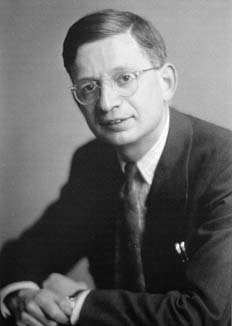
Sir Rudolf Peierls (1907-1995) was a German-born British physicist.

In March 1940, Peierls and fellow collegue Otto Frisch co-authored the Frisch-Peierls memorandum, the first technical exposition of a practical atomic weapon. The memorandum included new calculations about the size and critical mass needed for an atomic bomb and the report helped ignite interest in the development of atomic weapons.

Following the signing of the Quebec Agreement in August 1943, Peierls joined the Manhattan Project as a member of the British team. Peierls was initially located in New York before being transferred to Los Alamos to work on the bomb.

Peierls was also responsible for the recruitment of Klaus Fuchs, a Soviet spy who work in the theoretical physics division at Los Alamos.

Rudolf Peierls’s Timeline
1907 Jun 5th Born in Berlin, Germany.

19251933 Studied at the Universities of Berlin, Munich, and Leipzig.

1940 Mar Published the Frisch-Peierls memorandum, the first technical exposition on the feasibility of developing an atomic bomb.

19431945 Worked on the Manhattan Project.

1945 Jul 16th Witnessed the Trinity test.

1968 Knighted as a Knight Bachelor.

1980 Received the Enrico Fermi Award.

1999 Sep 15th Died in Oxford, England.

William Penney, Otto Frisch, Rudolf Peierls, and John Cockroft. Photo courtesy Atomic Heritage Foundation.

Related Profiles

Ray H. Williams

Tinian Island

Ray Williams was a member of the 1st Ordnance Squadron in the 509th Composite Group in Wendover, Utah and on Tinian Island in the Pacific in 1945.

Stanley Crouse, Jr.

Tinian Island

Stanley Crouse, Jr. served in the 509th Headquarters and Base Services Squadron. 

W. Maddox

Chicago, IL

W. Maddox worked in the shop at the University of Chicago’s Metallurgical Laboratory (“Met Lab”) during the Manhattan Project.

Donald “Moll” Flanders

Los Alamos, NM

Donald Flanders was an American mathematician who worked on the Manhattan Project at Los Alamos. Flanders was a group leader in the Theoretical Division headed by Hans Bethe.