


November 2, 2021 Newsletter
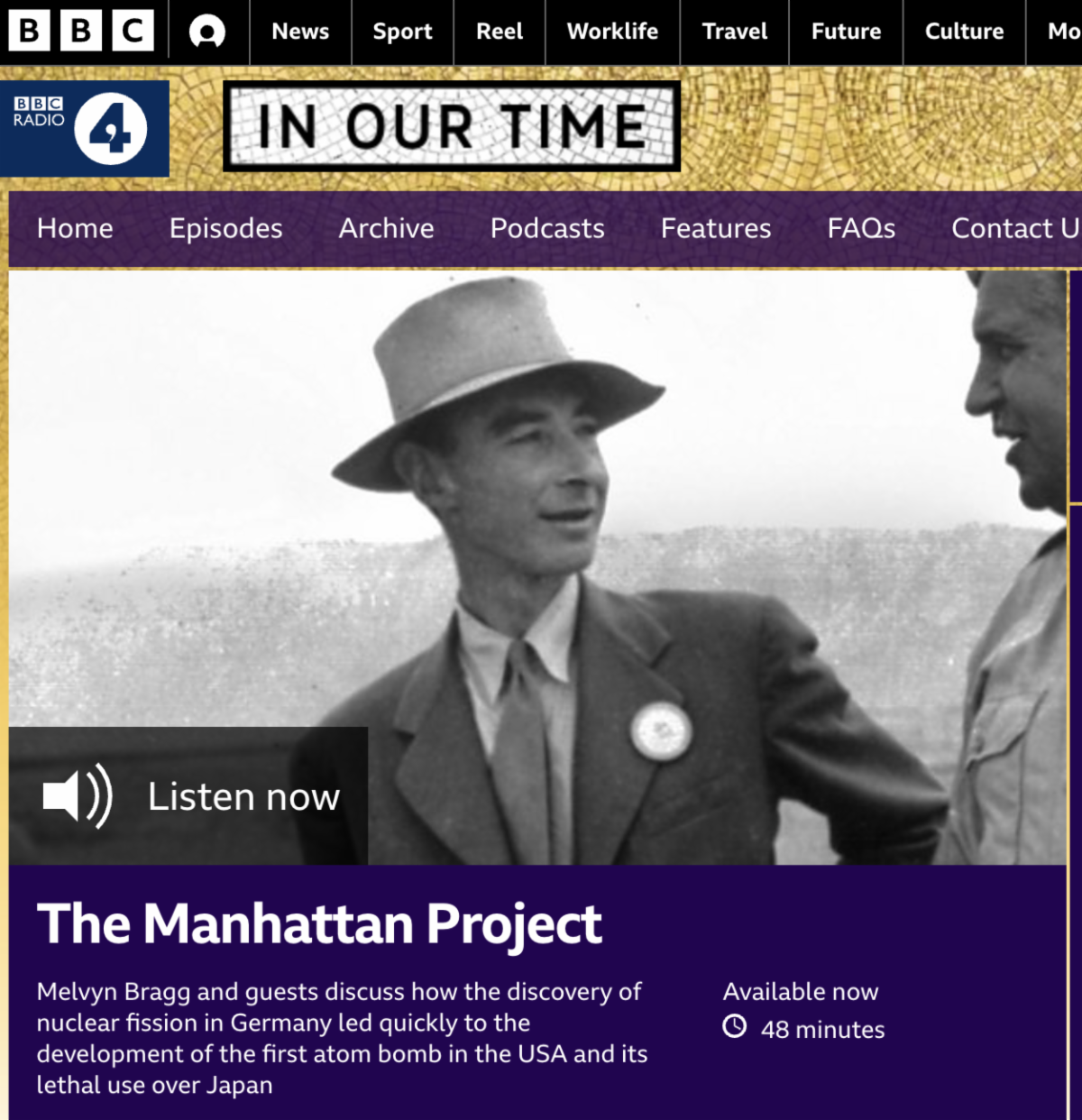
This issue features a recent BBC In Our Time podcast on the Manhattan Project (see website) hosted by Melvyn Bragg with Frank Close, Cameron Reed and Cynthia Kelly.
This issue also pays tribute to Martin J. Sherwin, a wonderful friend of AHF who won the Pulitzer Prize with co-author Kai Bird for their biography of J. Robert Oppenheimer, American Prometheus. The book is going to be a feature film in 2023!
Just released is another film, “Adventures of a Mathematician.” This one focuses on Stan Ulam, a Polish refugee who worked on the Manhattan Project at Los Alamos.
Next is an article on how the Los Alamos National Laboratory confirmed Robert Christy’s role on designing the “Christy Gadget.”
Finally, this issue recognizes George C. Marshall, Chief of Staff for the US Army during World War II. Marshall orchestrated the Allies’ operations and advised the President on the Manhattan Project. His home is preserved in Leesburg, VA.
In Our Time: The Manhattan Project
On October 7, 2021, BBC Radio 4 aired an In Our Time podcast on the Manhattan Project. The long-time program host Melvyn Bragg (above, photo courtesy of the BBC) led a discussion on the development and use of the atomic bomb.
Guests included Frank Close, physics professor emeritus at the University of Oxford, Bruce Cameron Reed, physics professor emeritus at Alma College, Michigan, and Cindy Kelly, founder and president of the Atomic Heritage Foundation. Click on this link to listen to the podcast.
In Our Time is one of the most popular radio series in the U.K. As Melvyn Bragg said in The New Yorker interview on August 1, 2021, “I think the fascination of knowledge is an addiction. And I sometimes think the fascination of knowledge is the meaning of life.”
Tribute to Martin J. Sherwin
We are very sad to report that Martin (“Marty”) J. Sherwin died in October at 84. Sherwin had a long and distinguished career as an historian of nuclear weapons development and policies.
In 2005, Sherwin and his co-author Kai Bird won a Pulitzer Prize for American Prometheus, a biography of J. Robert Oppenheimer. As reported in the New York Times’ obituary, the day he died Sherwin learned that director Christopher Nolan’s movie based on American Prometheus will star Cillian Murphy as Oppenheimer. The movie is scheduled for release in 2023.
Sherwin devoted 25 years to researching and writing American Prometheus. The Atomic Heritage Foundation’s “Voices of the Manhattan Project” website includes some 70 recordings taken by Sherwin. The interviewees include Norris Bradbury, Louis Hempelmann, Haakon Chevalier, David Hawkins, Robert Serber, Robert Wilson, Stanislaus Ulam, Joseph Rotblat, Hans Bethe, Robert Christy and dozens of others who played a prominent role in the Manhattan Project and afterwards.
Most recently, Sherwin published Gambling with Armageddon: Nuclear Roulette from Hiroshima to the Cuban Missile Crisis. Talmage Brown wrote in the New York Times’ review on October 13, 2020 that the book “should become the definitive account” of nuclear weapons history from 1945 to 1962.
Based on Sherwin’s extensive research and with dramatic prose, the book “tells what happened behind the scenes in the Soviet Union and the United States, under water in Soviet submarines, and in the thoughts and communications of those who held the fate of the world in their grasp.” (quote from Elaine Tyler May, author of Fortress America.)
Sherwin has left a rich legacy for future generations interested in the Manhattan Project and the history of nuclear weapons. He was a wonderful colleague and friend who will be greatly missed.
Adventures of a Mathematician
A new feature film “Adventures of a Mathematician” is based on the autobiography of Manhattan Project veteran Stanislaus Ulam. On September 27, 2021, producer Lena Vurma and director Thor Klein gave a behind-the-scenes talk at the Los Alamos Historical Society. Filmed in Germany, the set recreated Fuller Lodge. Polish actor Philippe Tlokinski plays Ulam.
Born in Poland in 1909, Stan Ulam was a brilliant mathematician and nuclear physicist. From 1936 to 1939, Ulam spent the academic years at Harvard University and summers in Poland. With war imminent, Ulam left Poland for the last time on August 20, 1939 and became an assistant professor at the University of Wisconsin-Madison.
Recruited by Hans Bethe to work at Los Alamos in 1943, Ulam was instrumental in creating the implosion-type plutonium bomb. After the war, he collaborated with Edward Teller on the Ulam-Teller design for the hydrogen bomb.
In 1938, Françoise Aron Ulam left France for the United States to be an exchange student and stayed to earn a Masters in comparative literature at Mount Holyoke. The Ulams married in 1941 and moved to Los Alamos in early February 1944.
Their daughter Claire was born in Los Alamos in July, one of the many babies whose birth certificate listed PO Box 1663 as the place of birth. Sadly, Claire Ulam Weiner recently died of a sudden heart attack in Santa Fe, reminiscent of her father’s death at 75 in 1984.
AHF’s website has interviews with Ulam by Martin Sherwin (1989) and Richard Rhodes (1983).
A trailer for the Samuel Goldwyn production of “Adventures of a Mathematician” is here. The film was released to theaters on October 1, 2021 and is available on iTunes and Apple TV.
Confirming “Christy Gadget”
Robert Christy (above, image courtesy of Los Alamos National Laboratory) was a young Canadian scientist who studied under J. Robert Oppenheimer at the University of California, Berkeley while earning his PhD in theoretical physics. He joined the Manhattan Project in February 1942 at the University of Chicago, and later relocated to Los Alamos when Oppenheimer recruited him on a visit to Chicago.
Working in the Theoretical Implosion group at Los Alamos, Christy proposed a novel design of the plutonium pit. His solid core design was adopted and the Trinity Test device became known as the “Christy Gadget.”
According to an article in The Vault by Thomas Chadwick, credit for the design has been in dispute for years. British historian Lorna Arnold asserted that the design was invented by Rudolph Peierls, a member of the British Mission to Los Alamos. Oxford physicist Frank Close (also on the recent BBC podcast) also credited Peierls based on “authoritative histories.”
Recently, archivist Danny Alcazar and physicist Mark Chadwick of the Los Alamos National Laboratory uncovered records in the National Security Research Center. The documents include the original handwritten draft of the patent in Christy’s name alone and 1986 recordings of Christy and Peierls. According to the Center’s director Alan Carr, these documents “demonstrate that Christy is, in fact, the primary architect of the design.”
After decades of dispute, Christy’s role and the nickname “Christy Gadget” are validated.
George C. Marshall Home, Leesburg, VA
On September 1, 1939, George Catlett Marshall (1880-1959) was sworn in as Chief of Staff of the US Army and soon became an indispensable advisor to President Franklin D. Roosevelt. According to David L. Roll’s George Marshall: Defender of the Republic, Roosevelt chose Dwight D. Eisenhower to command OVERLORD, the D-Day invasion in Europe, saying, “I can’t sleep unless Marshall is in Washington.”
Roosevelt appointed General Marshall to the top policy group responsible for overseeing the research and development of the atomic bomb. As Marshall explained in an interview, “I had to get the money and direct all these preliminary operations and the construction of the affair. Not that I knew anything about the technique at all…I spent so much time with the Encyclopedia Britannica or the dictionary I finally just gave it up, deciding that I never would quite understand it all.” (From an interview with biographer Frank Pouge)
In September 1942, Marshall chose General Leslie R. Groves to run the project for the Army Corps of Engineers. Many meetings were held in Marshall’s office or Secretary of War Stimson’s adjoining one in the Pentagon to discuss the project.
From a military perspective, Marshall believed that the atomic bombings were necessary. However, months before Hiroshima he urged President Truman to target military or manufacturing centers and warn Japanese civilians.
In 1941, Marshall and his wife Katherine purchased the Dodona Manor in Leesburg, Virginia, about 45 miles west of Washington, DC. They used the house as a weekend retreat and looked forward to retiring there.
Immediately after the war, Marshall was recruited to be special envoy to China. He then became Secretary of State (1947-49) and championed the European Recovery Program that became known as the Marshall Plan. The US initiative provided $13 billion to Western Europe to help overcome the devastation of World War II.
After rebuilding the American Red Cross as its President (1949-1950), Marshall became Secretary of Defense during the Korean War (1950-52). Finally retiring in 1952, Marshall enjoyed living in the Dodona Manor until his death in 1959.
in the early 1990s, several prominent Leesburg citizens were determined to save the house from possible demolition and purchased it for $2.3 million. After spending $4.5 million on renovations, the house opened as a museum and the George C. Marshall International Center in 2005.
A National Historic Landmark, Dodona Manor is well worth visiting. Below is Marshall’s favorite room where he enjoyed long conversations with friends and visiting officials. Here he loved reading history and biography. On a lighter note, he watched “I Love Lucy” and other 1950s shows on a small screen TV.
When he died in 1959, he was mourned worldwide in recognition of his leadership during World War II and for his role in aiding Western Europe’s recovery. A substantial share of the funds raised for the house came from grateful Europeans.