


February 5, 2021 Newsletter
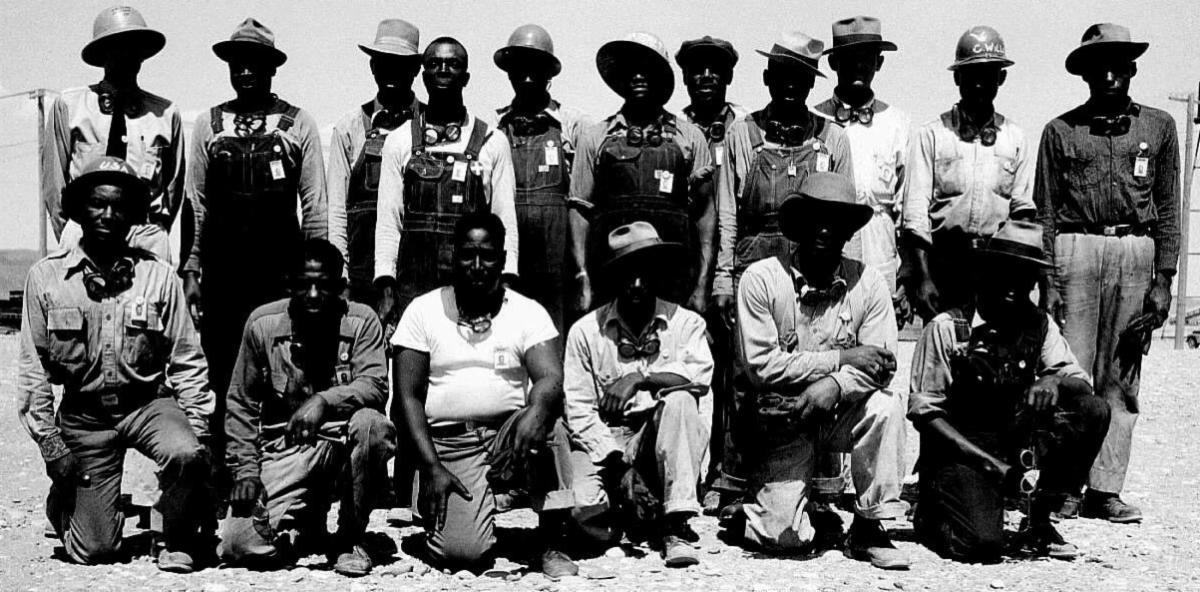
After mounting pressure from A. Phillip Randolph, Bayard Rustin and other Black civil rights leaders, President Franklin D. Roosevelt issued an Executive Order prohibiting discrimination by the defense industry. This action opened up opportunities for hundreds of thousands. Above is a photo of workers at Hanford. In honor of Black History Month, this issue highlights the contributions of African Americans to the Manhattan Project.
On February 13, 14, 20 and 21, C-SPAN3 American History TV is featuring six oral histories from the Atomic Heritage Foundation’s collection.
This newsletter also reports on two new treaties and a newly released book, Atomic Bomb Island, on Tinian Island’s role in the Manhattan Project. Enjoy!
Opening Opportunities For All
In 1941, A. Phillip Randolph and other Black leaders threatened a March on Washington, DC with 50,000 people to protest racial discrimination in the war industries. American companies were ramping up wartime production but refusing to hire Blacks. In response to Randolph and his colleagues, President Franklin D. Roosevelt issued Executive Order 8802.
This order prohibited “discrimination in the employment of workers in defense industries of Government because of race, creed, color, or national origin.” To enforce the order, a prohibition of discrimination clause was written in all defense contracts. “The democratic way of life within the Nation can be defended successfully only with the help and support of all groups within its borders.”
The prospect of higher-paying jobs and a better future drew many African Americans to the Manhattan Project. Thousands came to work at the huge construction projects at Hanford, WA and Oak Ridge, TN. Others worked in top-secret research at Columbia University and the University of Chicago.
As George Warren Reed who worked at the Metallurgical Laboratory at UChicago told his son, “My life story would be very different had not World War II intervened with the need to more fully utilize all the nation’s manpower and with the continued opening up of opportunities to all.”
African Americans in the Manhattan Project
In May 2019, AHF released a “Ranger in Your Pocket” program on “African Americans in the Manhattan Project.” Over 20 videos trace the movement of Blacks from the South as part of the Great Migration and capture their experiences during and after the Manhattan Project.
AHF website’s article “African Americans and the Manhattan Project” sheds light on the “hidden heroes” of the Manhattan Project, such as Jasper Jeffries (top row, second from right below), J. Ernest Wilkins and George Warren Reed who worked at the Metallurgical Laboratory at the University of Chicago. Photo courtesy of James Schoke.
C-SPAN3 American History TV:
Manhattan Project Series in Febuary
Beginning Saturday, February 13, C-SPAN American History-TV is showing six oral histories from AHF’s “Voices of the Manhattan Project” collection. Here is the schedule for next weekend:
2pm ET Saturday February 13: Larry O’Rourke, who was a member of the Special Engineer Detachment and worked at Columbia University and then Oak Ridge on the gaseous diffusion process. He remembers a pep talk by General Groves saying, “Every tube may mean a life.”
3:20pm ET Saturday February 13: James Forde, who worked as a young technical assistant at Columbia University’s Nash Garage laboratory which tested barrier tubes for the gaseous diffusion process.
2pm ET Sunday February 14: Virginia Coleman, who worked as a chemist at the Y-12 plant in Oak Ridge. Coleman was featured in Denise Kiernan’s “The Girls of Atomic City.”
Three other interviews will be broadcast on February 20 and 21. These include CJ Mitchell who came from northeast Texas right after high school to work at Hanford; Roger Rohrbacher who worked at B Reactor at Hanford as an instrument engineer; and Dimas Chavez who moved to Los Alamos at age 6 when his father took a job constructing the laboratories.
See c-span.org/history to check C-SPAN3 American History TV for the schedule.
United Nations Treaty on the Prohibition of Nuclear Weapons
On January 22, 2021, the United Nations Treaty on the Prohibition of Nuclear Weapons became international law. As former Secretary of Defense William J. Perry wrote in the Bulletin of the Atomic Scientists, the Treaty “creates a bold vision of a nuclear weapons-free world, shifting our focus to the inhumane aspect impact of these weapons and proclaiming a global consensus to address this existential issue…The treaty won’t end nuclear weapons any time soon, but it represents an important step in that direction.”
Since 1982, the Mayors of Hiroshima and Nagasaki have led Mayors for Peace, a worldwide organization of nearly 8,000 mayors working towards the abolition of nuclear weapons. In February 2019, AHF interviewed Mayor Katzumi Matsui of Hiroshima (photo above, right) and Mayor Tomihisa Taue of Nagasaki (photo above, left).
In his interview, Mayor Matsui said, “It is very, very important to convey what happened here in 1945 to the next generation… The memory of the atomic bombing is fading. I hope that a lot of people, especially young people, will understand such a tragedy should never happen again.”
Mayor Taue emphasized that “The power to create peace not only relies on the political leaders, but also civil society… On behalf of the hibakusha and the citizens of Nagasaki, I provide perspectives from the beneath the mushroom cloud.”
The United Nations Treaty is a major milestone. Congratulations to the Mayors for Peace, the International Campaign to Abolish Nuclear Weapons (ICAN), and others who worked hard to achieve this. As Beatrice Fihn accepted the 2017 Nobel Peace Prize on behalf of ICAN said, “The story of nuclear weapons will have an ending, and it is up to us what the ending will be. Will it be the end of nuclear weapons or will it be the end of us?”
Extension of New Start Treaty
On November 2, 1945, J. Robert Oppenheimer addressed his Manhattan Project colleagues in Los Alamos, “If atomic bombs are to be added to the arsenals of the warring world, then the time will come when mankind will curse the name of Los Alamos and Hiroshima.”
Despite appeals from Oppenheimer and many Manhattan Project scientists, the Cold War nuclear arms race continued for over forty years. The chart prepared by Our World In Data traces the peak with some 70,000 active nuclear weapons in the 1986 and declining in the following decades after the collapse of the Soviet Union in 1991. However, more than ten thousand remaining nuclear warheads still pose an untenable threat to the security of the world today.
On February 3, 2021, the United States extended the New START Treaty with the Russian Federation for five years. This treaty maintains verifiable limits on Russian intercontinental ballistic missiles, submarine launched ballistic missiles and heavy bombers until February 5, 2026. The extension of the New Start Treaty buys time to avoid a costly, dangerous arms race and make further progress in curbing the threat of nuclear weapons.
Atomic Bomb Island
Don A. Farrell has produced a magnificent volume that captures the dramatic but often overlooked role that Tinian Island in the Mariana Islands played in World War II. Captured from the Japanese in July 1944, Tinian soon had the single largest airfield complex in World War II. The island became the launch pad for long-range B-29 bombers which could attack Japan 1,500 miles away.
Tinian’s most significant role during the war was delivering the atomic bombs dropped on Hiroshima and Nagasaki. Project Alberta, headed by Captain William “Deak” Parsons, was dedicated to making the atomic bombs operational. Fifty-one men were stationed on Tinian (see photo at bottom) while others supported the effort stateside.
This team worked closely with the 509th Composite Group. Created by the Army Air Forces in 1944, the 509th were responsible for flying the modified B-29 Superfortress and delivering the atomic bombs to Japan.
Farrell describes in gripping detail the multiple crises that plagued the Bockscar’s mission to Nagasaki. First the plane circles for 45 minutes waiting to rendezvous with the observer plane, burning precious fuel. Running low on fuel, they discover that clouds are obscuring both their initial target (Kokura) and secondary target (Nagasaki). The plane has just enough fuel for one pass over Nagasaki before heading to Okinawa.
Should the Bockscar crew ignore orders and use radar to sight the target? Jettison the 10,265-pound bomb in the ocean en route to Okinawa? Jeopardize all by attempting to land with the bomb on an unfinished runway on Okinawa? Clearheaded and calm, Commander Frederick L. Ashworth’s leadership (see photo below)–and luck with the cloud cover–proved invaluable to the mission.
The 440-page book is well-researched, well-written and a great contribution to history, ideal for students, educators and others interested in World War II and the Manhattan Project. In addition to providing the larger context of World War II history, Farrell pulls together personal insights, photographs and amazing details that make Tinian’s stories compelling.